> ## Documentation Index
> Fetch the complete documentation index at: https://docs.frankieone.com/llms.txt
> Use this file to discover all available pages before exploring further.

# Fraud Prevention and Risk-Based Onboarding Overview

> Integrate FrankieOne's fraud signals and risk-based decisioning into your onboarding flow with OneSDK and our KYC API.

## Introduction

A significant challenge faced by many businesses today is balancing fraudulent account opening risk with a smooth user experience during onboarding. This often leads to high friction for low-risk users and not enough scrutiny for high-risk profiles.

The FrankieOne solution adapts the verification process to each user's unique risk profile, ensuring low-risk users enjoy a fast, frictionless journey while high-risk applicants undergo additional, necessary identity checks.

Onboarding fraud checks apply to individual entities only. Organization entity (KYB) onboarding does not currently include fraud checks.

### How Risk-Based Onboarding Works

<Frame>
  <img src="https://mintcdn.com/frankieone-f5583b1b/MpEYW70dy4W-choU/images/docs/fraud-risk-based-onboarding.webp?fit=max&auto=format&n=MpEYW70dy4W-choU&q=85&s=ce5995829dd73a1c6a288cc4975227c5" alt="Flowchart showing risk-based onboarding: initial fraud signal assessment, risk score determination, and dynamic verification paths for low-risk, medium/high-risk, and very high-risk users" width="2000" height="1125" data-path="images/docs/fraud-risk-based-onboarding.webp" />
</Frame>

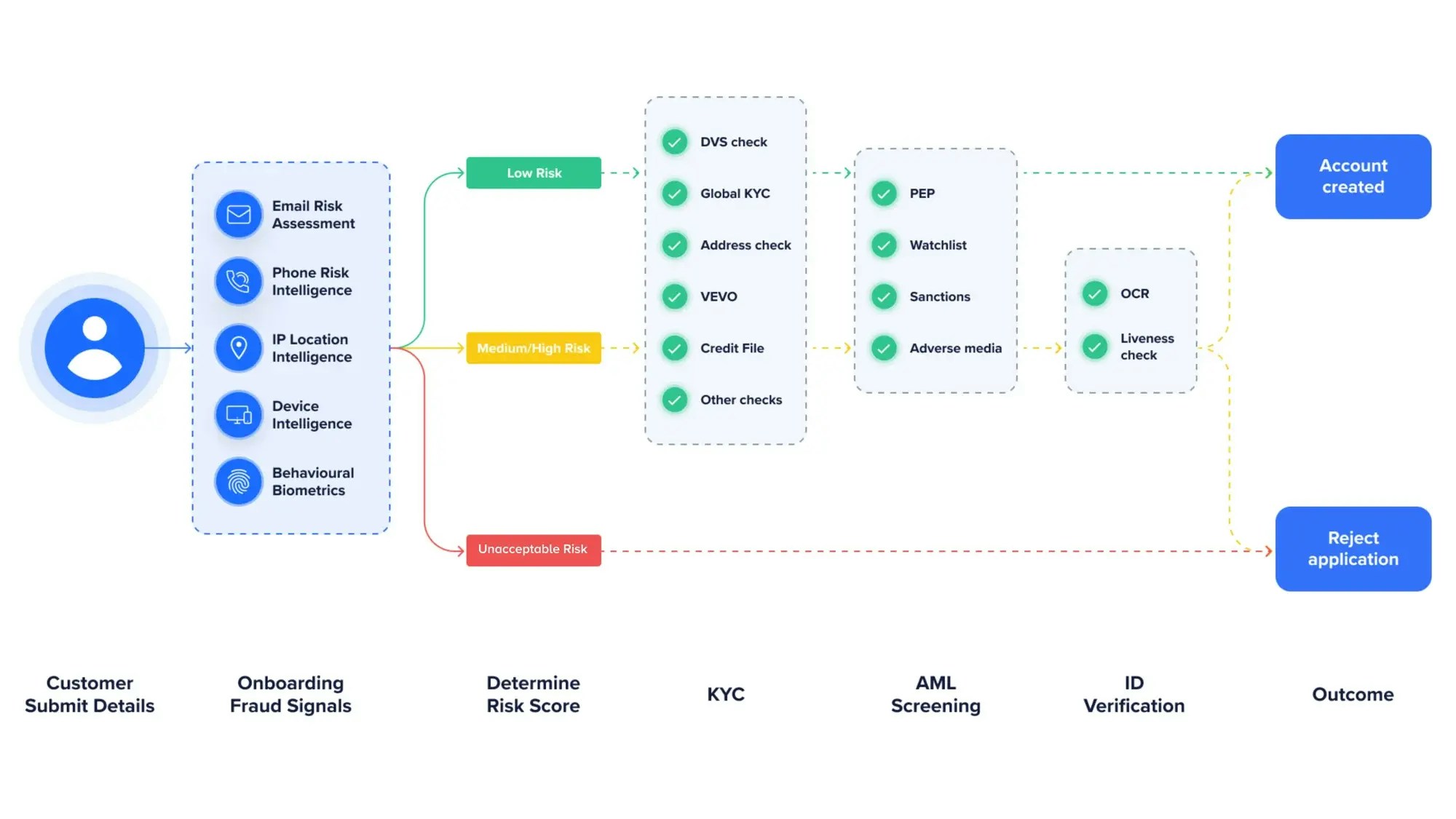
Our risk-based onboarding model assigns each user a real-time risk score, categorizing them as low, medium, high or very high risk. This allows you to apply the right level of verification at every step, blocking fraud early without adding friction for genuine customers.

<Steps>
  <Step title="Initial Fraud Signal Assessment">
    As a customer submits their details, our solution assesses fraud risk in the background using real-time intelligence from device, phone, and email signals. This happens instantly without disrupting the user's experience.
  </Step>

  <Step title="Determine Risk Score">
    Based on the initial signals, a risk score is calculated to determine if the user is Low, Medium/High, or Very High Risk.
  </Step>

  <Step>
    **Apply Dynamic Verification**

    The user's journey adapts based on their risk level.

    <span style={{backgroundColor:"#22c55e", width:"15px", height:"15px", borderRadius:"2px", display:"inline-block", verticalAlign:"middle", marginRight:"8px"}} /> **Low Risk** users proceed with minimal checks and can be onboarded quickly.

    <span style={{backgroundColor:"#f97316", width:"15px", height:"15px", borderRadius:"2px", display:"inline-block", verticalAlign:"middle", marginRight:"8px"}} /> **Medium or High Risk** users are prompted for additional verification steps, such as KYC checks, ID validation, or biometrics.

    <span style={{backgroundColor:"#ef4444", width:"15px", height:"15px", borderRadius:"2px", display:"inline-block", verticalAlign:"middle", marginRight:"8px"}} /> **Very High Risk** applications can be rejected immediately, stopping bad actors before they create an account.
  </Step>
</Steps>

### Key Features and Signals

Our solution leverages best-in-class providers to assess risk in real-time, using a powerful combination of device intelligence and behavioral biometrics to filter out bad actors.

<Card title="Device Intelligence" icon="mobile-screen-button">
  Identifies devices through cookies and device fingerprinting to flag suspicious sessions. Signals include:

  <div><svg xmlns="http://www.w3.org/2000/svg" viewBox="0 0 448 512" aria-hidden="true" focusable="false" style={{color:"#22c55e", width:"16px", height:"16px", marginRight:"8px", display:"inline-block"}}><path fill="currentColor" d="M434.8 70.1c14.3 10.4 17.5 30.4 7.1 44.7l-256 352c-5.5 7.6-14 12.3-23.4 13.1s-18.5-2.7-25.1-9.3l-128-128c-12.5-12.5-12.5-32.8 0-45.3s32.8-12.5 45.3 0l101.5 101.5 234-321.7c10.4-14.3 30.4-17.5 44.7-7.1z" /></svg> Emulator, Proxy, and VPN detection</div>

  <div><svg xmlns="http://www.w3.org/2000/svg" viewBox="0 0 448 512" aria-hidden="true" focusable="false" style={{color:"#22c55e", width:"16px", height:"16px", marginRight:"8px", display:"inline-block"}}><path fill="currentColor" d="M434.8 70.1c14.3 10.4 17.5 30.4 7.1 44.7l-256 352c-5.5 7.6-14 12.3-23.4 13.1s-18.5-2.7-25.1-9.3l-128-128c-12.5-12.5-12.5-32.8 0-45.3s32.8-12.5 45.3 0l101.5 101.5 234-321.7c10.4-14.3 30.4-17.5 44.7-7.1z" /></svg> Browser fingerprinting and Device ID</div>

  <div><svg xmlns="http://www.w3.org/2000/svg" viewBox="0 0 448 512" aria-hidden="true" focusable="false" style={{color:"#22c55e", width:"16px", height:"16px", marginRight:"8px", display:"inline-block"}}><path fill="currentColor" d="M434.8 70.1c14.3 10.4 17.5 30.4 7.1 44.7l-256 352c-5.5 7.6-14 12.3-23.4 13.1s-18.5-2.7-25.1-9.3l-128-128c-12.5-12.5-12.5-32.8 0-45.3s32.8-12.5 45.3 0l101.5 101.5 234-321.7c10.4-14.3 30.4-17.5 44.7-7.1z" /></svg> Remote desktop detection</div>
</Card>

<Card title="Behavioral Signals" icon="brain">
  Detects fraudsters through their intrinsic behaviors and patterns during the onboarding process. Signals include:

  <div><svg xmlns="http://www.w3.org/2000/svg" viewBox="0 0 448 512" aria-hidden="true" focusable="false" style={{color:"#22c55e", width:"16px", height:"16px", marginRight:"8px", display:"inline-block"}}><path fill="currentColor" d="M434.8 70.1c14.3 10.4 17.5 30.4 7.1 44.7l-256 352c-5.5 7.6-14 12.3-23.4 13.1s-18.5-2.7-25.1-9.3l-128-128c-12.5-12.5-12.5-32.8 0-45.3s32.8-12.5 45.3 0l101.5 101.5 234-321.7c10.4-14.3 30.4-17.5 44.7-7.1z" /></svg> Typing and mouse signals</div>

  <div><svg xmlns="http://www.w3.org/2000/svg" viewBox="0 0 448 512" aria-hidden="true" focusable="false" style={{color:"#22c55e", width:"16px", height:"16px", marginRight:"8px", display:"inline-block"}}><path fill="currentColor" d="M434.8 70.1c14.3 10.4 17.5 30.4 7.1 44.7l-256 352c-5.5 7.6-14 12.3-23.4 13.1s-18.5-2.7-25.1-9.3l-128-128c-12.5-12.5-12.5-32.8 0-45.3s32.8-12.5 45.3 0l101.5 101.5 234-321.7c10.4-14.3 30.4-17.5 44.7-7.1z" /></svg> Use of copy, paste, and autofill functions</div>

  <div><svg xmlns="http://www.w3.org/2000/svg" viewBox="0 0 448 512" aria-hidden="true" focusable="false" style={{color:"#22c55e", width:"16px", height:"16px", marginRight:"8px", display:"inline-block"}}><path fill="currentColor" d="M434.8 70.1c14.3 10.4 17.5 30.4 7.1 44.7l-256 352c-5.5 7.6-14 12.3-23.4 13.1s-18.5-2.7-25.1-9.3l-128-128c-12.5-12.5-12.5-32.8 0-45.3s32.8-12.5 45.3 0l101.5 101.5 234-321.7c10.4-14.3 30.4-17.5 44.7-7.1z" /></svg> Hesitation, distraction, and context switching</div>
</Card>

<Card title="Contact and Location Intelligence" icon="location-dot">
  Validates user-provided information against trusted data sources.

  <div><svg xmlns="http://www.w3.org/2000/svg" viewBox="0 0 448 512" aria-hidden="true" focusable="false" style={{color:"#22c55e", width:"16px", height:"16px", marginRight:"8px", display:"inline-block"}}><path fill="currentColor" d="M434.8 70.1c14.3 10.4 17.5 30.4 7.1 44.7l-256 352c-5.5 7.6-14 12.3-23.4 13.1s-18.5-2.7-25.1-9.3l-128-128c-12.5-12.5-12.5-32.8 0-45.3s32.8-12.5 45.3 0l101.5 101.5 234-321.7c10.4-14.3 30.4-17.5 44.7-7.1z" /></svg> **Email Risk Assessment:** Checks email age, domain risk, and associated account behavior.</div>

  <div><svg xmlns="http://www.w3.org/2000/svg" viewBox="0 0 448 512" aria-hidden="true" focusable="false" style={{color:"#22c55e", width:"16px", height:"16px", marginRight:"8px", display:"inline-block"}}><path fill="currentColor" d="M434.8 70.1c14.3 10.4 17.5 30.4 7.1 44.7l-256 352c-5.5 7.6-14 12.3-23.4 13.1s-18.5-2.7-25.1-9.3l-128-128c-12.5-12.5-12.5-32.8 0-45.3s32.8-12.5 45.3 0l101.5 101.5 234-321.7c10.4-14.3 30.4-17.5 44.7-7.1z" /></svg> **Phone Risk Assessment:** Determines if a phone is VOIP or a landline and analyzes its behavior.</div>

  <div><svg xmlns="http://www.w3.org/2000/svg" viewBox="0 0 448 512" aria-hidden="true" focusable="false" style={{color:"#22c55e", width:"16px", height:"16px", marginRight:"8px", display:"inline-block"}}><path fill="currentColor" d="M434.8 70.1c14.3 10.4 17.5 30.4 7.1 44.7l-256 352c-5.5 7.6-14 12.3-23.4 13.1s-18.5-2.7-25.1-9.3l-128-128c-12.5-12.5-12.5-32.8 0-45.3s32.8-12.5 45.3 0l101.5 101.5 234-321.7c10.4-14.3 30.4-17.5 44.7-7.1z" /></svg> **IP Location Intelligence:** Detects proxy use and analyzes risk based on IP country, city, and timezone.</div>
</Card>

## Integration essentials

<Columns cols={2}>
  <Card title="KYC API" icon="code">
    Use our [**KYC API**](/docs/fraud-checks-guide) to perform email and phone checks, and retrieve combined risk scores.

    [**Learn more** …](/docs/fraud-checks-guide)
  </Card>

  <Card title="OneSDK" icon="mobile-screen-button">
    Capture device and behavioral biometrics data with our [**OneSDK**](/docs/sdk-reference/device-module) for web and mobile platforms.

    [**Learn more** …](/docs/sdk-reference/device-module)
  </Card>

  <Card title="Portal" icon="desktop">
    Access fraud insights and manage results through our user-friendly portal.

    [**Learn more** …](/docs/fraud-checks)
  </Card>
</Columns>
