

Purpose
This guide explains how your systems connect with FrankieOne from an architectural perspective, including:- System-to-system communication patterns
- Data flow and sequencing
- Infrastructure considerations
- Security and compliance requirements
- Common integration architectures for different use cases
Audience
- Solution Architects — design the integration architecture
- Technical Leads — understand system boundaries and responsibilities
- Project Managers — understand technical dependencies and timelines
- Security Teams — understand data flows and security requirements
Contents
- Core Architecture Concepts
- Integration Pattern 1: Hybrid (API + Portal)
- Integration Pattern 2: Fully Automated (API-Only)
- Integration Pattern 3: Platform/Marketplace Model
- Technical Considerations
- Security & Compliance
- When to Consult FrankieOne
- Summary: Choosing Your Integration Approach
Core Architecture Concepts
System Boundaries
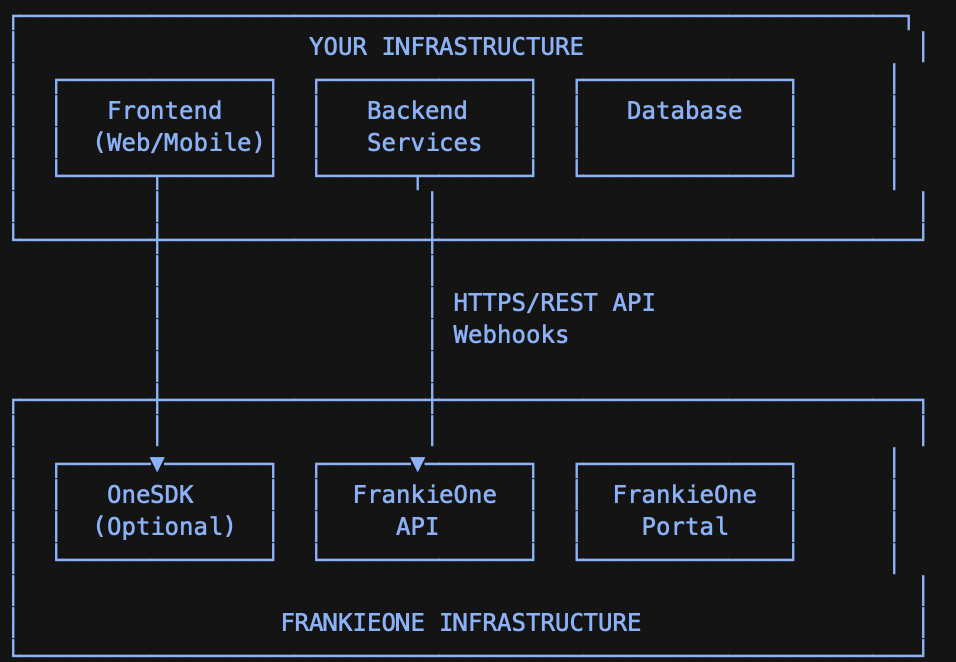
Key Components
FrankieOne API
- Protocol: HTTPS REST
- Authentication: API Key + Customer ID headers
- Base URLs:
- V2 UAT:
https://api.uat.frankie.one/v2/ - V2 Production:
https://api.frankie.one/v2/ - V1 Production:
https://api.kycaml.frankiefinancial.io/compliance/v1.2/
- V2 UAT:
- Create individuals and organisations
- Execute verification workflows
- Retrieve results
- Update entity data
Webhooks
- Direction: FrankieOne → Your system
- Protocol: HTTPS POST
- Format: JSON
- Purpose: Asynchronous event notifications
- Retry policy: Exponential backoff (up to 50 retries over 24 hours)
FrankieOne Portal
- Access: Web UI (HTTPS)
- Authentication: Username/password + MFA
- Purpose: Case management, manual review, reporting
- Users: Compliance and operations teams
OneSDK (Optional)
- Type: Client-side JavaScript SDK
- Deployment: Embedded in web or mobile apps
- Purpose: Document capture, biometrics, form collection
- Communication: Direct to FrankieOne API using session tokens
Data Flow Fundamentals
At a high level, the standard FrankieOne verification flow looks like this:- Create an entity and execute a workflow via API
- Receive an immediate response (synchronous result + IDs you’ll need later)
- FrankieOne sends webhooks if the workflow status changes (or completes asynchronously)
- Your webhook handler should acknowledge quickly and then fetch full results
- Your system applies decision logic (PASS / FAIL / REVIEW) and proceeds with onboarding
End-to-end flow diagram
Practical notes
- Always store identifiers from step 2 (e.g.
requestId,entityId, and any workflow/execution IDs returned), so you can fetch results later. - Treat webhooks as a signal, not the full truth. A best practice is:
- Respond
200quickly, then - Fetch the latest results via API, then
- Update your database and trigger downstream actions.
- Respond
- Make webhook handling idempotent (duplicate deliveries can occur).
Example webhook handling approach (recommended)
Integration Pattern 1: Hybrid (API + Portal)
Overview
Use this pattern when you want automated verification with manual review handled in the FrankieOne Portal. Common scenarios- Fintech onboarding with edge-case review
- E-commerce seller verification
- Lending platforms with risk-based decisioning
Architecture
Key Decisions
Where does entity data live?
Recommended: Dual storage- Your system remains the source of truth
- FrankieOne stores verification context
- Link records using a stable reference
Synchronous vs Asynchronous Workflows
Synchronous- Immediate response (2–10 seconds)
- Best for real-time onboarding
- Immediate acknowledgement
- Final result via webhook
- Best for high volume or long-running checks
Webhook Architecture (Recommended)
- HTTPS only
- Idempotent processing
- Fast response under 5s
Integration Pattern 2: Fully Automated (API-Only)
Overview
Use this pattern when you want complete control and already have (or plan to build) your own case management system. Common scenarios- High-volume lending platforms
- Crypto exchanges
- Enterprises with Salesforce or ServiceNow
Characteristics
- No operational dependency on the FrankieOne Portal
- All decisioning handled in your systems
- FrankieOne used purely as a verification engine
Responsibilities
You build- Case management system
- Review UI
- Escalation workflows
- Decision logic
- Verification execution
- Data sources
- Audit trail
Integration Pattern 3: Platform / Marketplace Model
Overview
Use this pattern when your customers need to verify their own end-users, and you provide compliance as a service. Common scenarios- Marketplaces
- SaaS platforms
- White-label onboarding products
Parent / Child Account Model
API Example (Child Routing)
Technical Considerations
Authentication & Secrets
- Never expose API keys client-side
- Store keys in a secrets manager
- Rotate keys regularly
Networking
- Outbound HTTPS (443) to FrankieOne APIs
- Inbound HTTPS (443) for webhooks
- IP allowlisting available on request
Error Handling
Security & Compliance
Data Protection
- All data encrypted in transit (TLS 1.2+)
- Encrypted at rest (AES-256)
- SOC 2 Type II & ISO 27001 compliant
Logging Guidance
Log- Request IDs
- Entity IDs
- Status transitions
- API keys
- Full PII
- Documents or biometrics
When to Consult FrankieOne
Contact FrankieOne if you have:- High-volume requirements (>10k/day)
- Multi-region or data residency needs
- Complex platform or marketplace architecture
- Custom workflow or data source requirements
- Production performance issues
Summary: Choosing Your Integration Approach
Next Steps
- Identify your integration pattern
- Review architecture with FrankieOne
- Implement in UAT
- Test webhooks and failure scenarios
- Go live and monitor